Tuesday, July 29, 2008

Rural Learning Center St. Croix

AHAInstitute, coupled with various partners are currently exploring the construction of a Rural Learning Center in St. Croix, Virgin Islands. In a continuing effort to re-define “rural” and re-vitalize rural communities around the world, St. Croix has been recognized with potential loci for such a facility. After all, there are few places as rural as an Island. St. Croix hosts a difficult arid cultivation base, a lack of quality water, impoverished indigenous population, and a wealthy “snowbird” residency that adds little to the local economy – all important vectors well suited to the solutions of a Rural Learning Center. Design elements for the Center include:
  • Modern facility with digital media learning applications, conference rooms, distance learning media, and “tourist learning” ready accommodations.
  • At least 50% energy resources derived from Solar and Wind technologies.
  • Fully functioning aquaculture farm producing revenue generating produce and fish end product.
  • Microbial-based Sustainable Technology Ponds converting 75% of the Center’s waste in to sale-able Premium Grade Potting Soil.
The Center will form a tightly woven relationship with the St. Croix University of Agriculture to address the specific needs of rural island communities; and serve as a model for rural island community development around the world.

Tuesday, July 22, 2008

Mapping the NEW (VIRTUAL RELATIONAL) WORLD: Foundational/Formal/Theoretical RS Development Outline-Part II {Re:SYN1-Maps}

RELATIONAL SYSTEMS
DEVELOPMENT
- Annotated Outline –
This post, again beginning with the identifier {Re:SYNx-Maps, where x=1to7}, follows our preceding posts, http://relatedone.blogspot.com/2008/05/mapping-new-virtual-relational-world.html and http://relatedone.blogspot.com/2008/06/mapping-new-virtual-relational-world.html and
continues the post at
MONDAY, JUNE 16, 2008
Mapping the NEW (VIRTUAL RELATIONAL) WORLD: Foundational/Formal/Theoretical RS Development Outline-Part I {Re:SYN1-Maps}

RELATIONAL SYSTEMS
DEVELOPMENT

I. NOTIONAL FOUNDATIONS
II. GENERAL RELATIONAL THEORY CONSTRUCTION

Beginning from the Specific RS Presumptions of Subsumption [Distinction (Boundary) as per George Spencer-Brown] and Image [Sign as per Charles Sanders Peirce], an approach to the next successful stage in the mainstream frontier transformations of the SYSTEMIC foundations of Human Knowledge will take THE FORMas THE FORM of a general [meta order(ing)] theory of theory formation with components—objects (specific SYSTEMS), operations (specific INTER-SYSTEMIC RELATIONS) and preferred order(ing) relations (specific SYSTEMIZING RELATIONS).

NOTE ON FORMALIZATION
It is taken as a given that the development of a Formal Theory requires attention to all of the following Relations (R) and Systems (S). The brief outline of this present post, however, is only directed at identifying certain of the necessary RS’s and does not address completion of their organization nor attend to their sufficiency as a Formal Theory, although this is the immediate strategic intent of this research in the construction of a SPECIFIC RELATIONAL THEORY.
FORMAL (IMAGE) SYSTEM (FS)
  • Specify primitive S’s and R’s

  • Define how RS’s should be constructed from primitive S’s & R’s

  • Presume certain primitive RS’s (axioms; postulates)

  • Specify IaR (rules of inference) stating conditionally how other RS’s (theorems) are to be derived from the primitive RS’s.

  • Certain RS’s shown to be explicit RS’s derivable by IaR from the primitive RS’s

  • Meta-RS’s about the FS itself which relate certain of its parts in specified ways
IMAGE & ACTIONAL RELATIONS (RELATIONS TO EXPERIENCE)

The following paragraphs provide a brief summary of the precursors to formalization, i.e. an order and its derivative calculus, the latter taken as a formulation of the disorder experientially related to the given order, which also implies a reorder(ing) format (methodology).

(1) ORDER Formalisms

Order theory dictates the way in which an algebra can be extended to a calculus by assigning numerical values to pairs of elements of a poset (a set of elements together with a binary ordering relation is called a partially ordered set, or a poset) to describe the degree to which one element includes another. The result is a methodology (Order theory) that can be used to generalize an algebra to a calculus by relying on consistency with the underlying order to derive the laws of the calculus.

In terms of ORDER formalisms, the Laws of Form [Spencer-Brown, G. (1969). Laws of form (4th ed.). New York: E. P. Dutton], built on the assumed notions of ‘distinction’ (Subsumption) and ‘indication’ (Image), advanced the foundational formulation of a mathematics of distinguishability (boundary mathematics) which was shown to imply a Boolean algebra (having an interpretation as Boolean logic-deductive reasoning-where implication is among logical assertions in situations of complete certainty=order) as one of its many consequences, and which has now been expanded to General MultiBoundary Formalisms (Lattices, Algebras, etc. (recognizing that every algebra has its arithmetic) and their associated Calculus) wherein
  • A set of logical statements ordered by implication gives rise to a Boolean lattice (or a Boolean algebra), and
  • The Boolean lattice of logical statements induces the free distributive lattice of questions (the question lattice or algebra).

FROM IMAGE AND SUBSUMPTION TO MATHEMATICS AND LOGIC
(AND SYNTHETIC INTELLIGENCE/MIND)
Although this brief formal snippet may at first seem opaque, it can be transparent (enlightening) to realize that by simply grasping the concept of “distinction” the world of mathematics and the formal theories constructed thereon, which are the core essence of the work addressed herein, are within an Occam Simple grasp.
The theme of this argument, following an editorial extraction by the authors from George Spencer-Brown, Laws of Form: Evolution of Consciousness, is that a universe comes into being when a space is severed by drawing a distinction. By tracing the way we represent such a severance, we can begin to reconstruct, with an accuracy and coverage that appear almost uncanny, the basic forms underlying linguistic, mathematical, physical, and the life sciences, and can begin to see how the familiar laws of our own experience follow inexorably from the original act of severance. The act is itself already remembered, even if unconsciously, as our first attempt to distinguish differences in a world where, in the first place, the boundaries can be drawn anywhere we please. (Spencer-Brown 1969)
The expectation here is simply for an “open” impression by the reader regarding the arguments herein; quite obviously, the inclusive argument can not be joined in this limited exposition. On the other hand the partial arguments here presented are “informative” when focusing attention on this open impression.
To introduce the Occam Simplicity of creating Formal Systems, we begin with Personal Experience of the Existence of The Form of Relational System (RS), but with only the Presumption of imaging Experience as an Essence thereof. Let this experience be imaged asthat is, the Person (imaged as the observer “eye”) is within The Form of RS with no other essence. Let this existence be called (imaged as) the Void (or R-Space or more formally, a Potential RS). The Void is not a mathematical (i.e. a formal “RS”) or physical space, nor is it a “System” of any sort. It is the absence (Non-Existence) of any System, and thus it possesses no attributes of any kind, including emptiness. [For this insert, see generally Shoup, R. (2008). Boundary institute for the study of foundations. Retrieved June 17, 2008, from http://www.boundary.org/; referencing (Shoup 1994)]
Within the Void create (image) the simplest fundamental Essential Presumption as subsumption subsuming the notion of distinction. By drawing a distinction, we form a boundary with two sides, the first System in our Void (R-Space). We can visualize this first distinction by a closed curve (of arbitrary shape) in the plane as shown in Figure 1.
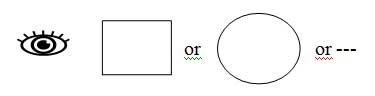
Figure 1. The first distinction.
The distinction may be taken both as a System, e.g. an object (an area defined in the space), and as a Relation, e.g. an action (an injunction to cross from the outside to the inside). At this ultimately simple level, System and Relation as object and action or state and event or thing and change are united (undifferentiated) in a single concept, i.e. System and Relation are a Whole.
The functionality of the distinction may be seen more clearly when we draw a second distinction (Figure 2). Given a single object distinguished from the Void, only two possibilities exist for the second distinction: 2.a) as an additional identical distinction from the Void, or 2.b) as a distinction from (within) the existing object.
Figure 2. Two ways of combining two distinctions --
the axioms of the boundary mathematics (logic and arithmetic).
In the first case, we have two identical distinctions from the Void taken together, which is just the same as one distinction. (At this level of extreme simplicity, either we have distinction from the Void or we have not.) In the second case, a distinction from the first distinction (since there is no Other distinction) can only refer back to the Void. The second arrangement can also be thought of as a function -- one distinction "applied to" or "surrounding" another. Using these two relations as axioms, any arrangement of boundaries (multiple distinctions including distinctions within distinctions) in the plane (Void) can be simplified to either one distinction or the Void.

The foregoing brief perspective on the mathematics of distinction has grown into a general candidate for an approach to a universal language for formal systems, MultiBoundary Mathematics. Inherent to this latter is a Boundary Logic from which Boolean Logic is derivable as a special case and which is leading to a more powerful computer design. [See generally Bricken, W. (2007). Boundary mathematics. Boundary logic. Retrieved June 17, 2008, from http://wbricken.com/index.html; referencing (Bricken 2002; 2004)] Generally, taking a universal formal system as an axiom system with the property that any other consistent axiom system can be interpreted within it, the mathematics of distinction implies a mathematics of subsumption which, in turn, implies a Membership theory as a first step towards a universal language for mathematics. [Etter, T. (2006), Three-place Identity. Private Publication. Saratoga, CA.: Boundary Institute]

(2) DISORDER Formalisms

NOTE: R.Elated’s RELATIONISM treats the notion of probability as being composed of a “subSystemic probability” (to be referred to herein as “probability” in the lower case) which corresponds to the classical Bayesian understanding as foundationally grounded by Cox (see below) and a “Systemic probability” (to be referred to herein as “PROBABILITY” in the upper case) which, in one instance, corresponds to the generalized entropy of Cox as a measure of relevance in the query algebra (also see below). When referring generally to the notion of probability, “Probability” will ordinarily be used; however, the reader may have to rely on the context since the author’s diligence in this matter is expected to be frequently deficient.

To gain true understanding in any area of study, the foundations need to be repetitively re-explored. Cox’s investigations into the role of consistency of probability theory with Boolean algebra were a crucial initial step in this new exploration. The Algebra of Probable Inference/Inquiry (Cox, R. T. (1961). The algebra of probable inference. Baltimore, MD: Johns Hopkins Press) has finally been recognized as the succinct and profound foundational form of formalized Probability in representing DISORDER.

The effect of Cox’s contribution to probability theory was to generalize Boolean implication among logical statements to degrees of implication represented by real numbers (NOTE: by varying the algebra and extending the number system, e.g., to complex or quaternion numbers, other formulations of Probability such as quantum probability arise), which are manipulated using rules derived from consistency with the Boolean (or other underlying) algebra. These rules are known as the sum rule, the product rule and Bayes’ Theorem, and the measure resulting from this generalization is “probability”.

Generalizing a particular function of the question lattice leads to a valuation called relevance, which is a measure of the degree to which a statement answers a given question. Cox conjectured that this degree can be expressed as a generalized entropy which has subsequently been shown to be the case.

For the foregoing part of this section as well as the next section see generally Fry, R. L. (2001), MaxEnt2001, Bayesian Inference and Maximum Entropy in Science and Engineering: 21th International Workshop at Johns Hopkins University, Baltimore MD (USA). August 4-9, 2000; AIP Conference Proceedings 617. May 2002. pp. 410-432. Edited by Robert L. Fry. Available at: proceedings.aip.org (volume 617), http://www.blogger.com/www.jhuapl.edu/maxent2001.

(3) REORDERING Formalisms

The method of Maximum Entropy Inference [Cox, R. T. ( 1979), “Of inference and inquiry, an essay in inductive logic,” in The Maximum Entropy Formalism, edited by R. D. Levine and M. Tribus, The MIT Press, Cambridge, 1979, pp. 119–167]; [See generally Jaynes, E. T. (2003), Probability Theory: The Logic of Science, Cambridge Univ. Press, Cambridge; 2003; including references (Jaynes 1957, 1968, 1979, 1985)] generalized to Optimum Systemic(SubSystemic) Probabilistic Inference (OS(sS)PI) [See generally Hamann, J. R. at http://www.relationalsystems.net and references therein (Hamann 1968, 1969a, 1969b, 1972)] within RELATIONAL SYSTEMS as the progenitor of the formal basis for REORDERING the DISORDER completes THE FORM.

It is now well-understood that probability theory is literally an extension of (deductive) logic. Integrating the logic of inference (probability) with the logic of inquiry (relevance=entropy) yields a powerful formulation of inductive reasoning (logic) when completed through the use of the Principle of Maximum Entropy for assigning prior probabilities since this maximizes the relevance of the parameterization of the subject system.

CONJECTURE: It is also speculated here, based on real, but partial evidence, that the third mode of reasoning, i.e. abduction, may be formalizable by invoking a MiniMax Entropy Principle. Formal inclusion of abduction is necessary to complete a system of automated, autonomous inquiry/inference/intuition. [Hamann, J. R. (2007). Computational autognomics: An introduction. In R. Gudwin & J. Queiroz (Eds.), Semiotics and intelligent systems development (pp. 287-309). Hershey, PA: Idea Group Inc.]

The third post (III) in this series Mapping the NEW (VIRTUAL RELATIONAL) WORLD: Foundational/Formal/Theoretical RS Development Outline-Parts I, II & III {Re:SYN1-Maps} will follow in the not too distant future.

Wednesday, July 2, 2008

CO-CREATING POSSIBLE UNIVERSAL RELATIONAL FUTURES

DEFINING THE RESEARCH PROCESS
[Co-Intelligence in Co-Creative Research]
This AHA!Institute blog will be the only entry point inviting open participation in the evolving Community of Relational Researchers addressing THE 7 SYNs: Strategic Viewpoints of Possible Relational Futures.
  • SYN1: Creation of Interrelated Relational (RO3) Sign Systems
  • SYN2: Synthesis of Field as Interrelated Relational (RO3) Sign Systems
  • SYN3: Synthesis of Matter as manifest FIELD
  • SYN4: Synthesis of Life as dependent on the origin of sign in FIELDS as RO3
  • SYN5: Synthesis of Mind as both being and meta-imaging RO3
  • SYN6: Synthesis of Language in RO3, and
  • SYN7: Synthesis of Society AsItIsToBe as Interrelated Relational (RO3) Sign Systems
See also the following regarding the 7SYNs:
http://relatedone.blogspot.com/2007/03/in-begining-was-word-and-now-mindclone.html

http://relatedone.blogspot.com/2007/12/aha-institute-relational-systems-re.html

http://relatedone.blogspot.com/2008/03/asitisinccom-portal-to-future-as-it_09.html


RESEARCH PARTICIPATION WILL BE INITIATED EFFECTIVE OCTOBER, 2008, WITH NOTICE OF THE SPECIFIC OPENING DATE TO BE PUBLICIZED ON THIS BLOG SHORTLY IN ADVANCE OF SAID DATE. THE INITIATING SPECS FOR SYN4,5,&6 WILL BE POSTED BEFORE THE END OF 2008. THE AUTOGNOMIC INTELLISITE (IN THE http://www.truethinker.com/ APPLICATION) AS A KNOWLEDGE DEVELOPMENT AND DIFFUSION SYSTEM (SEE BELOW) WILL BE DEPLOYED AS THE RESEARCH DEVELOPMENT AND MANAGEMENT SYSTEM.


AS OF THE OPENING DATE, to participate in this Community, begin by Adopting-a-Gnome as per the procedure laid out in the post herein titled, Adopt-a-Gnome. Read the section entitled “What is the Adopt-a-Gnome Program” and then follow the directions under “How does one Adopt-a-Gnome?” As a TrueThinker, having subscribed through
one immediately becomes a participating Relational Researcher simply by way of the incorporation of their personal MindClone (MyKnowledgeBank) in the AHA!Institute 7SYNs Community KnowledgeBank; this latter serves as a resource knowledge-base for this research. More specifically, however, each open-entry participant is free to engage actively in this research at whatever level of Pragmatic Knowledge Value they competently offer as assessed by the AHA! Community–Builder.


AUTOGNOMIC INTELLISITE
as a

KNOWLEDGE DEVELOPMENT

and

DIFFUSION SYSTEM

(Foreseeing an Autonomous Scientific Intelligence)


The following content was edited by the author hereof in part from:
  • Your AutoGnomics™ Update (July 21, 2006) and A Sixty-Second Summary of: TrueThinker.com™:The Intelligent Web Site (October 23, 2006), written by Harvey and Carl Rohde, The Greenwich Division of Ai3, P.O. Box 9, Greenwich, CT 06836-0009
A Brief History of Idea Acceptance
Throughout history there have been “telling” examples of great ideas which have gone through three distinct phases. The first phase was characterized by being deemed sacrilegious, whimsical, or just plain silly. The second phase involved the intellectual pioneers seeking to prove the utility and validity of their idea. The third phase was heralded by the cries of the crowd, “We always believed it was true!

Vision Before Manifestation
Catching the vision of AutoGnomics™ is rather like the legend of the old Native American Sachem. The ancient “Medicine Man/Woman” was a seer of dreams, an interpreter of visions. These Sachems traveled in their thoughts where others could not go. For most of us as early investors, AutoGnomics has been largely visionary, almost dream-like. And yet, not unlike the Sachems, there has been a need for patience. The Sachems knew that any kernel of truth had to be placed in good soil, to be tended by a gentle hand, and then allowed to grow at its own intrinsic rate to full maturity in preparation for the harvest.

A Patient Family

Our Ai3/AutoGnomics Family has shown remarkable patience. Every one has envisioned, in his or her own way, a part of the possibility of AutoGnomics--of the vast potential of this unique leading-edge science.

A Radically New Application
Over the past five years the effort has been focused on an original application worthy of the AutoGnome's potential ubiquitous applicability. Such an application would need to be revolutionary in its scope, visionary in its conception, and available to a very broad customer market. As such, it should be a candidate for fulfilling Bill Gates’ challenge:

New York Times, March 1, 2004
“Microsoft, Amid Dwindling Interest,
Talks Up Computing as a Career” by Steve Lohr-- Bill Gates, ''If you invent a breakthrough in artificial intelligence, so machines can learn, that is worth 10 Microsofts.''

This first application should fill an apparent need that competing technologies have shown themselves unable to address.

The Solution Environment

It has become the norm in the experience, for example, of small business enterprises that they need to hire special information technologists using additional technology/tools to teach/train their employees in the requisite skills to enable them to use the web search tools. Hence, the "golden age of information technology" has created the problem of an “info-glut” which, as a result of efforts to resolve that problem, has led to the further problem of a “tool-glut” with its inherent added problem of limiting solutions due to a “limited set of skilled tool users”. To address these challenges, Ai3 has introduced its Intellisite™ (Intelligent WebSite™) technology which can ultimately effectively act as an autonomous agent assisting or replacing the human computer operator in interacting with the CyberUniverse™.

The Intellisite™: A Virtual Replica of Individual Intelligence
An Intellisite™ (generically branded as TrueThinker.com™) is a constructed software environment (a website) with an embedded form of the AutoGnomic Technology. Hence the AutoGnome is a synthetic intelligence (a WebGnome™) residing in this virtual environment which, with its continuous adaptive learning from mimicking the user’s behavior, will grow into a likeminded replica (MindClone™) of a user-self acting in the virtual world of the Internet with capabilities initially including:
  • knowledge organization [learning] (manual, supervised and automated categorization);
  • knowledge creation [thinking] (ideation, autonomous search, and automated community building), and
  • knowledge applications [acting] (capital development, management, & investment and autonomous entrepreneurs).
TrueThinker.com™
The present TrueThinker experience includes these features:

  • My Home webpage, a dashboard or homepage that you can personalize as your portal to the Internet.
  • My KnowledgeBank, where you can manually, or via your AutoGnome automatically, store your relevant and valued information (i.e. Knowledge) so you can find it easily
  • My Communities, where you can join or create groups of people with the same social, business, research or other interests to share resources and hold public or private discussions.
What's more, you can access TrueThinker and your organized knowledge files from any computer, making your accumulated knowledge on just about anything accessible from anywhere.

How TrueThinker Can Begin To Work For You
To access the TrueThinker site, simply enter http://www.truethinker.com/ in your browser of choice. The first act is to register your personal information. Once you have opened the TrueThinker.com intelligent website, pause and take a few moments to look around. See the unique layout. Sample TrueThinker’s novel approach to information gathering and its ease of operation in organizing your personal KnowledgeBank. Sample the tutorial available to users of the site. You can also expect ongoing growth in the functional intelligence of the AutoGnomic features resident in the site.

Benefits Of TrueThinker
TrueThinker is not just an idea, but is a technology that needs to be experienced for it to be actionally conceptualized. A core function of TrueThinker, i.e. an operator-less intelligent technology to augment human intellect, is now nearing availability. This allows potential Relational Researchers to become involved in a technology that will provide each their own MindClone which, as an Autonomous Scientific Intelligence (AScI), might serve as a personal Research Assistant and thus allow the Researcher a depth of research participation never before conceived.

The remainder of this post has been excerpted from
a paper by Jon Ray Hamann, An AutoGnomic Intellisite,
to be published in October, 2008.

Intellisite Derivatives - Autonomous Scientific Intelligence
The Intellisite obviously has a broad spectrum of applicability apart from its key functionality as an individual's mirrored Intelligence/Knowledge, in particular as an Autonomous Scientific Intelligence (AScI), a Collective-AutoGnome (CoGnome) and the CogWeb (cognitive network of Intellisites).


AScI
A first generative instantiation of the AutoGnome deriving from its form as a general [meta order(ing)] theory of theory formation is as an Autonomous Scientific Intelligence (AScI) which promises to automate the scientific method.
CoGnome
Assigning a priority MetaQuery/Response status to a selected WebGnome which inter-connects two or more Intellisites in a Network provides a computerized collective intelligence, the CoGnome.
The CogWeb is, by definition, the implementation of the CoGnome for Network Decision-Making by Intellisite-defined groups, organizations, communities and societies.

While the Intellisite itself was focused on the development of a semiotic engine as an Individual Intelligence, the full potential of individual intellect, be it human or machine, is realized in groups; hence the Automated Community Builder functionality of the Intellisite. This collective creativity, while related to the intelligence of the individual, is actually a feature not only of the Decision Network’s inquiry/inference processes (the CoGnome), but more generally of the Network Architecture. Since it is increasingly evident that smart aggregates of humans are frequently more effective decision makers than individuals, this CogWeb architecture collectively technologically enables Co-Intelligence in Co-Creative Research.

Monday, June 30, 2008

2 Philosophical Houses Of Fly Tying...

One of the guiding principles here at the AHA!Institute is that each person, regardless of their background or profession can make a meaningful contribution to the collective effort. Physicists have something to learn from Janitors and Janitors have something to learn from Physicists. My personal understanding of many of the weightier ideas expressed here may not always be immediate, but by staying present to the conversation quite often the underlining principles reveal themselves. Lately, I’ve been returning to the conversation many of the programmers are having in their attempt to construct the Autognome, the "learning" and “thinking” component of Ai3’s flagship Online Knowledge Management and Community Building Tool. The conversation as I interpret it goes something like this: “We are training the Autognome to look at sets of raw data/information. The Autognome logically forms "signs" with respect to this data/information and then groups those signs in terms of similarity into "classes (or categories)". These “signs” and "classes" form character sets for a "tentative language". The Autognome uses this language to interpret new data and then check its results for accuracy with respect to experience." With all of this in mind I have set out to apply a similar line of thought to my approach toward tying flies for competitive fly fishing. I will look at a set of data (fish feeding behavior); Form signs from that data (tie flies to invoke positive reactions); Cluster data (group positive reactions); Then apply those signs to new data, record, and modify for accuracy (use flies in different settings). This may not be Noble Prize winning work, but it could mean quite a bit to the angler. The basis for my quantitative work will stand on the theory of “Suggestive” rather than “Imitative” fly tying. There are generally 2 philosophical houses of fly tying: the first sets out to key reaction strikes based on stimuli such as shape, color, and size while the second seeks to reproduce fish forage as closely as humanly possible with artificial materials. Please look for updated reports on this “Query” in the upcoming weeks and months.

ANNOTATED CHRONOLOGICAL RECORD OF POSTS

ANTICIPATING A PUBLICATION
(an EBOOK)
REPRESENTING THE POSTS AT
EACH SUBSEQUENT DATE
AT WHICH THERE IS COMPLETED
APPROXIMATELY 49 SEQUENTIAL POSTS
The Formulation and Initiating Construction of this Blog began in and was in process throughout the month of March, 2007. The postings for the first nine posts during that period were saved in reverse chronological (i.e. actual chronological) order by fabricating the date stamps from March 12th to March 4th. These dates were arbitrarily chosen simply to maintain the actual chronology of the construction events. From the Sunday, April 1, 2007 post and thereafter, the dated entries are the actual chronology.

Monday, March 12, 2007

AUDITION for the Ultimate VIRTUAL REALITY PLAY (See the following post, Adopt-a-Gnome, to sign up for an audition)

IN THE BEGINNING WAS THE WORD, AND---
(thinking and language are co-determinate)

Sunday, March 11, 2007

ADOPT-a-GNOME

WHAT IS A GNOME?
(a magical mind?!)

Saturday, March 10, 2007

RE-COGNIZING RELATION {Re:SYN1}

WHAT ARE THE TWO
FOUNDATIONAL NOTIONS
OF HUMAN EXPERIENCE?
(SYSTEM and RELATION)

Friday, March 9, 2007

RE-COGNIZING WHOLE/PART RELATIONS {Re:SYN1}

THE HOLISTIC PARADIGM SHIFT
(holism is becoming an experiental imperative)

Thursday, March 8, 2007

MINDing HUMANITY

AUTOGNOMIC (VIRTUAL) EDUCATION
(re-building education today from the perspective of a
transhumanist society of post-2063 which subsumes a
Virtual Autonomous CyberSociety of WebGnomes)

Wednesday, March 7, 2007

A PRAGMATIC ACTION METHODOLOGY

A METHODOLOGY FOR CO-CREATIVE (R)EVOLUTION

Tuesday, March 6, 2007

"LIFE ITSELF" AS IT IS {Re:Q1SYN4}

ON THE ORIGIN OF SIGN (=IMAGE)
AS A NECESSARY AND (POSSIBLY) SUFFICIENT
CONDITION FOR THE
EVOLUTIONARY ORIGIN OF LIFE

Monday, March 5, 2007

RELATIONAL SYSTEMS:Prolegomenon {Re:SYN1-RS Fdns}

FOUNDATIONS
(PERSONAL EXPERIENCE IS THE EXISTENCE OF
RELATION(AL) SYSTEM (R(S))
BY PRESUMPTION, R(S) IS THE ESSENCE
OF EXISTENCE (NON-EXISTENCE) OTHER THAN PERSONAL)

Sunday, March 4, 2007

MIND TRUST

THE RELATIONISTS
(the leaders of the Relational (R)Evolution in Gobal Society)

Sunday, April 1, 2007

AHA! INSTITUTE BLOG

INITIATING "DIABLOG"

Saturday, April 7, 2007

BEGINNING THE "RELATIONAL QUEST" {Re:SYN1}

IS THERE A NEED FOR URGENCY?
(in transitioning from a Systemic to a Relational paradigm)

Sunday, May 27, 2007

RELATIONAL SYSTEMS: Re-View {Re:SYN1-RS Fdns}

NOTIONAL FOUNDATIONS
(See also the posts on "Re-Cognizing Relation"
and "Relational Systems: Prolegomenon")

Friday, December 7, 2007

MIDWIFING "THE AGE OF RELATION" (Expected Delivery in 2012-2013){Re:SYN7-(R)Ev}

STRATEGIC ENVISIONING/ENACTMENT
of
RELATIONAL FUTURES
50 Years: 1963-2013


Sunday, March 9, 2008

ASITISINC.com: A Portal to the Future "AS IT IS/TO BE"{Re:SYN7}

MINDing the world through technology! SYNMIND

Monday, March 17, 2008

MIND Creating MIND: A CoCreative Re-Evolutionary Act {Re:SYN5-Prologue1}

SYNTHESIZING MIND:
A PERSPECTIVE

Wednesday, April 9, 2008

Without knowing that it is...


Monday, May 12, 2008

RE-CREATING SOCIETY: The Rural Perspective {Re:SYN7-RuralTransformations 1(RT1)}


Sunday, May 18, 2008

The Systems its members support...


Friday, May 23, 2008

Mapping the NEW (VIRTUAL RELATIONAL) WORLD: Formal/Theoretical Sketches Initially Focused on SynMIND {Re:SYN7-Maps}


Tuesday, May 27, 2008

From GROUPS to COMMUNITIES to SOCIETY: {Re:SYN7-Experiential Beginnings}

RE-CREATING SOCIETY
through the technology of
Synthetic Intelligence/Mind

Monday, June 9, 2008

My “mind of the known”


Monday, June 9, 2008

RELATIONAL EDUCATION

BACKGROUND LITERATURE
Relevant to
RELATIONAL EDUCATION

Tuesday, June 24, 2008

FUTURES VISIONING: 1963-2013{Re:SYN7}

REVIEW OF SOME
SELECTED AFFILIATED LINKS


AS IT IS
RELATIONAL SYSTEMS (RS) (aka RELATIONISM) [http://www.relationalsystems.net/]
ODODU [http://www.ododu.com/ ]


AS IT IS, INC.

[http://www.asitisinc.com/]
and [http://nextgenerationartificialintelligence.blogspot.com/].


INTELLISITE [http://www.truethinker.com/]

TRUEFARMER / RURAL TRANSFORMATIONS
Begin with [http://relatedone.blogspot.com/2008/05/re-creating-society-rural-perspective.html]
and continue through [ http://www.reimaginerural.com/]
to [http://www.rurallearningcenter.org/]

AS IT IS/TO BE
MINDING HUMAN CULTURE AS A WHOLE [http://relatedone.blogspot.com/2008/03/asitisinccom-portal-to-future-as-it_09.html]
The VISION - “Midwifing the Age of Relation - [http://relatedone.blogspot.com/2007/12/aha-institute-relational-systems-re.html]
The MISSION - Synthesizing MIND - [http://relatedone.blogspot.com/2008/03/mind-creating-mind-cocreative-re.html]
The STRATEGIC PLAN - 7SYNS = Strategic Viewpoints of Possible Relational Futures from 2008 to 2012-2013 [http://relatedone.blogspot.com/2008/07/co-creating-possible-universal.html ]

Unfettered surprise and goodwill...

“AHA!” moments come to us in many different sizes and with varying frequency. Although there are certainly adults who strive to create new knowledge in their lives, it is most certainly the children among us who have the upper hand. This is not so much a case where the child “knows” less and thus has more to be surprised about, but that children have yet to develop the mask of “knowing” that inhibits adults from regular surprise. With each passing year the collective human experience seems to build a structure of “knowing” so large that moments of unseen inspiration can rarely find their way in. Any person who has traveled to a foreign city on vacation can evidence an instance of this dilemma. Walking on the streets of a new land we are open to see all the wonderful details. A bird nesting in a tree, cracks in the sidewalk, the way light shines through a café window. When we break our mask of “knowing” and “open” our minds to the present new and exciting details begin to emerge. Children seem to live this way every day. I recently held a backyard party for my son’s 3rd birthday party. One of his friends, a 4 year old, was eating chips from a large bowl. He would selectively choose a chip, take a bite, and then toss it back in the bowl. A few elders commented on his unusual behavior. The next time the 4 year old came around I said: “Did you know the rule is when you take a chip, you’re supposed to eat it and not put it back?” With a look of unfettered surprise and goodwill to my “rule making” the 4 year old said: “oh, ok!” and went back to play.

Monday, June 16, 2008

Mapping the NEW (VIRTUAL RELATIONAL) WORLD: Foundational/Formal/Theoretical RS Development Outline-Part I {Re:SYN1-Maps}

RELATIONAL SYSTEMS
DEVELOPMENT
- Annotated Outline –
This post, again beginning with the identifier {Re:SYNx-Maps, where x=1to7}, follows our preceding posts, http://relatedone.blogspot.com/2008/05/mapping-new-virtual-relational-world.html


I. NOTIONAL FOUNDATIONS

EXPERIENTIALLY SPECIFIC:
Personal Experience is the Existence of RELATIONAL SYSTEM (RS).

PRESUMPTIVELY GENERAL
:
By Presumption, RS is the Essence of Existence (Non-Existence) Other than Personal

General RS Presumptions:

1. SS (Relational Order 1 or RO1)-MonoRelational;
2. SR (Relational Order 2 or RO2)-BiRelational;
3. RR (Relational Order 3 or RO3)-TriRelational; and
4. R(S)-NESS (Relational Order 0 or RO0)-SelfRelational

General Philosophical Presumptions:

1. Existence <=> Cosmos
from
2. Existence (Non-Existence) <=> CosmiChaos


PRESUMPTIVELY SPECIFIC:

Specific RS Presumptions:

1. IaR (Inter (Actional) Relation) of I (Image) and/or S (SubSumption)

Specific RS Formation Assumptions:

1. Pragmatic Action Methodology (PAM) attending to Extensive Exclusivity while being Occam Simplistic in all RS Formations

2. The Form - OrderDisOrderReOrder (ODORO) - is Necessary & Sufficient in Forming both Relations and Systems in RS Theory Creation

3. RetroSpective Formulations are a vision of a Transhumanist Future Culture/Society imported into current strategic RS Applications Modeling

Philosophical RS Formation Notions:

1. S (Totality or Whole)/Field/Energy-Information

2. sS (Component or Part)/Particle/Atom (with 2 experiential characteristics) (sS corresponds to subSystem)

3. IaR of S's and sS's through I &/or S in SS, SR, RR, or R(S)-NESS

Formal RS Notions:

1. Mathematical: Focused on Multi – I &/or S in RS

2. Logical: Focused on Multi – IaR of I &/or S in RS

Theoretical RS Notions:

1. Heterarcical/Hierarchical Forms: Systemantilectical Resolutions of Systemantic Paradoxes implies a Taxonomy of Levels (…Formalons, Nuclons, Chemons, Bions, Psychons, Socions, GnosTekons,…)

2. Optimum Sytemic (subSystemic) Probability Inference (OS(sS)PI)

EXPERIENTIALLY GENERAL:

1. System - as - Totality
a. RO1 is sufficient

2. System - as - Whole
a. RO3 is necessary since a Whole is not a S (is no-thing)
b. Field is Wholing R of R's
i. Field is Formalized as Max Order of R's (via OS(sS)PI)
ii. Particles are Holographic

The following sections will follow as needed.
II. GENERAL RELATIONAL THEORY CONSTRUCTION

III. A SPECIFIC EXAMPLE OF RELATIONAL THEORY CONSTRUCTION

The masterful competitor...

The French and Czechoslovakian National Fly Fishing Teams have been dominating International Competitive Fly Fishing since its inception in the 1980s. It is often said in competitive fly fishing circles: “a Frenchmen or Czech will catch almost every fish in any stream at any time.” As a competitive fly fisherman in training this proposition constantly wanders through my consciousness. To think that an angler could have such a high level of skill is intriguing. I have always been attracted to strategic games of the mind though. For a long time it was chess. I admired the player who could sit down with any person at any time and plot a concise win. In a way, these examples of masterful competitors intrigued me so, because they exemplified the potential of the human “mind” to map and solve seemingly unsolve-able problem sets. For me, the Chess board has been replaced by the Trout Stream. Trout are my worthy opponent. Water is my moving board. Rod, Line, and Flies are my pieces. Insects, light, and waves are the signs. Apply the right sequence of pieces to a certain set of signs and a fish is your reward. Miss one of those components and your net stays dry. Long ago I dropped my pursuit of mastering Chess because I read a book that outlined the variables. It was staggering and I thought I could never achieve that in my lifetime. However, I have come to learn, over the years, that many great competitors are not massive number crunching processors. Instead, they work off of simple proposition statements that prove their hypothesis. They continually digest pertinent information and then, to some extent, forget it. Play for the masterful competitor is just that, “play.” It comes easy. It is natural. A “mind” at play is much more apt to transform to changing variables. The goal now, is to piece together the great fragments of my life. To play a single game called my “life.”

Monday, June 9, 2008

Mapping the NEW (VIRTUAL RELATIONAL) WORLD: Concept Maps {Re:SYN1-Maps}

CONCEPT MAPS

REMINDER: This continuing post, which will also always begin with the identifier {Re:SYNx-Maps, where x=1to7}, will concentrate only on annotated text outlines and/or charts or tables or other graphic formats, i.e. “Maps”.
While reading the present brief post which is constructed via excerpts from a paper of Novak and Cañas on “Concept Maps”, refer also to our preceding post, http://relatedone.blogspot.com/2008/05/mapping-new-virtual-relational-world.html

FRIDAY, MAY 23, 2008
Mapping the NEW (VIRTUAL RELATIONAL) WORLD: Formal/Theoretical Sketches Initially Focused on SynMIND {Re:SYN7-Maps}

specifically the section on Relationalgraphs. Note that the notion of “Relation” as in the present post with varying names such as relationships or connecting lines or links, in Relational Systems terminology is of the Mono-Relational Form. Contrast this with the defining form for Tri-Relation and imagine a further level either within a Concept Map or as an extended kind of Concept Map in which Relations may exist between these links. This will indicate (suggest or point to) what is expected as the ultimate form of signification (mapping) of the NEW (VIRTUAL RELATIONAL) WORLD.

THE THEORY UNDERLYING CONCEPT MAPS AND HOW
TO CONSTRUCT AND USE THEM

Technical Report IHMC CmapTools 2006-01 Rev 01-2008
Joseph D. Novak
Professor Emeritus, Cornell University
and

Senior Research Scientist
Florida Institute for Human and Machine Cognition (IHMC)
Alberto J. Cañas
Associate Director
Florida Institute for Human and Machine Cognition (IHMC)


Introduction

Concept maps are graphical tools for organizing and representing knowledge. They include concepts, usually enclosed in circles or boxes of some type, and relationships between concepts indicated by a connecting line linking two concepts. Words on the line, referred to as linking words or linking phrases, specify the relationship between the two concepts. We define concept as a perceived regularity in events or objects, or records of events or objects, designated by a label. The label for most concepts is a word, although sometimes we use symbols such as + or %, and sometimes more than one word is used. Propositions are statements about some object or event in the universe, either naturally occurring or constructed. Propositions contain two or more concepts connected using linking words or phrases to form a meaningful statement. Sometimes these are called semantic units, or units of meaning. Figure 1 shows an example of a concept map that describes the structure of concept maps and illustrates the above characteristics.

Fig 1

Revised January 22, 2008. Cite as: “Novak, J. D. & A. J. Cañas, The Theory Underlying Concept Maps and How to Construct and Use Them, Technical Report IHMC CmapTools 2006-01 Rev 01-2008, Florida Institute for Human and Machine Cognition, 2008, available at:

http://cmap.ihmc.us/Publications/ResearchPapers/TheoryUnderlyingConceptMaps.pdf

RELATIONAL EDUCATION

BACKGROUND LITERATURE
Relevant to
RELATIONAL EDUCATION

The intent hereof is to initiate a diablog regarding Relational Education respecting the introduction by way of the preceding post http://relatedone.blogspot.com/2007/02/minding-humanity.html identified by

THURSDAY, MARCH 8, 2007
MINDing HUMANITY

AUTOGNOMIC (VIRTUAL) EDUCATION
(re-building education today from the perspective of a transhumanist society of post-2063 which subsumes a Virtual Autonomous CyberSociety of WebGnomes)

and emphasizing the following definition therein:

  • Definition: Teaching/Learning, taken as a semiotic act, is most simplistically a sign communication between a Teacher-Mind and a Learner-Mind intended to increase (evolve) the potential of the Learner-Mind to act and to increase (evolve) the concomitant potential value of said act to that Learner-Mind, and, as an imperative corollary, to the Collective (Common) Other-Mind.
CHARLES SANDERS PEIRCE (and other pragmatists)
See Phyllis Chiasson on Relational Teaching

JEAN PIAGET
Structuralism; Genetic Epistemology

HENRI BORTOFT
The Wholeness of Nature: Goethe’s Way toward a Science of Conscious Participation in Nature

MARIA MONTESSORI
The Montessori Method

PAULO FREIRE
Pedagogy of the Oppressed; Ecopedagogy

and the following from a coming post entitled “Mapping the NEW (VIRTUAL RELATIONAL) WORLD: Concept Maps {Re:SYN1-Maps}”

THE THEORY UNDERLYING CONCEPT MAPS AND HOW
TO CONSTRUCT AND USE THEM

My “mind of the known”

I recently spent a week fishing the West Branch of the Delaware River. A waterway widely known as holy land for the religion of fly fishing. Often difficult, never easy this river offers fly fishing people around the world a chance to test their wits and skills against wild trout with a prolific and quickly changing aquatic insect food base. For some time now my “fly fishing mentor” has been professing the effective importance of “Micro Nymphs” – tiny little mayfly imitations tied on minute hook sizes not even manufactured by many of the top suppliers. The hook is so small just an extra turn of thread will throw the proportions out of whack. While I wouldn’t even attempt to fish let alone tie these patterns 2 years ago - many months of patient practice at the fly tying bench and streamside have recently grown fruit. There are few feelings in the world as satisfying as the moment of unbridled discovery! I don’t mean the accumulation of a small solution or tool, but rather the moment when a discovery flies into your living radar screen from an origin you didn’t even know existed. Although my mentor could point the way, I would never have gained the mastery of this moment unless I spent those countless hours with the material of this epiphany. Now my vision has changed. I can see clearly a level of detail my “mind of the known” would never afford. The information was always there though …right in front of my eyes. I would like to increase the frequency of “aha” moments in my life. However, just like the computer processors of our world that will soon be outdated, my process of accumulating the knowledge necessary to spark “aha” moments is indeed outdated. If I could somehow increase the volume and scope of my “mind of the known”, I strongly believe true “aha!” moments could become a weekly or daily part of my experience.